
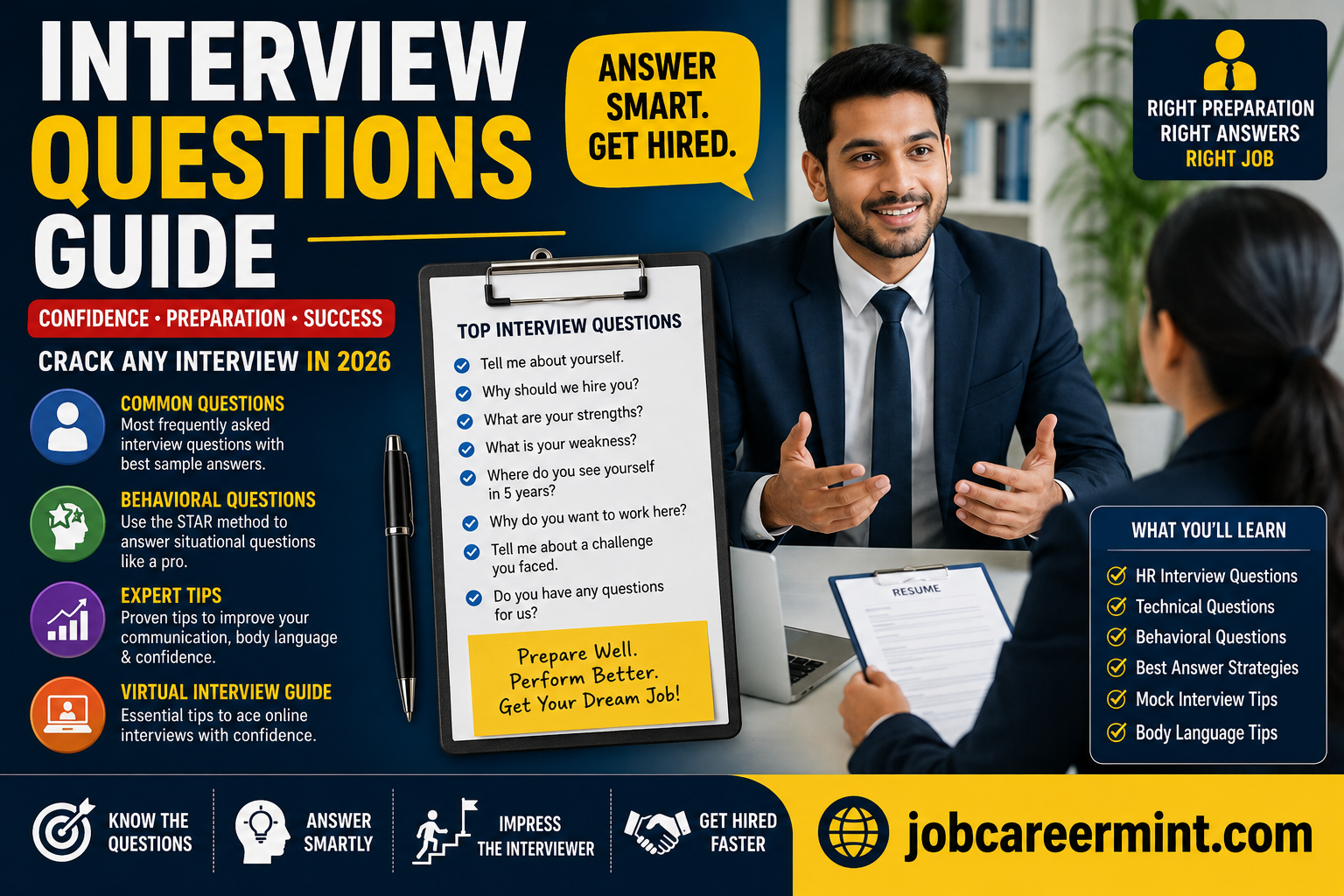
If you are frantically searching for a reliable Interview Questions Guide to survive the brutal 2026 job market, you have landed in the exact right place. Let’s be brutally honest for a second. Getting your resume shortlisted is just the warmup. The real nightmare starts when you sit across from a hiring manager and have exactly fifteen minutes to prove you aren’t just another average candidate.
Most job seekers walk into that room completely blind. They memorize a few robotic lines from a random YouTube short, freeze the second a tough question hits, and blow their chances before the HR even finishes their coffee. Recruiters today aren’t just checking your degree; they are heavily analyzing your body language, your adaptability, and whether you actually have the mindset to survive in their company.
This deep dive by Jobcareermint.com strips away the fake corporate fluff. We are going to show you exactly how to tackle the hardest interview questions this year, avoid the classic rookie traps, and negotiate your worth without sounding like a programmed machine.
1. “Tell Me About Yourself” (The Ultimate Trap)
This is the opening pitch, and 90% of candidates ruin it immediately. The interviewer does not want to hear your childhood backstory or your entire college timeline. They are testing your ability to summarize your professional value in under 60 seconds.
Stop rambling. Use the Present-Past-Future framework:
- Present: What are you doing right now? (e.g., “I am currently a junior developer specializing in Python…”)
- Past: What is your strongest relevant background? (e.g., “…before this, I built a data dashboard during my internship that saved the team 10 hours a week…”)
- Future: Why are you sitting in that chair? (e.g., “…and I am here because I want to bring that problem-solving approach to your specific growth team.”)
2. “Why Should We Hire You?” (The Confidence Test)
Never answer this emotionally. Saying “because I really need a job” or “because I am a hard worker” makes you sound desperate and completely generic. Every applicant claims they work hard.
You need to connect your hard skills directly to their biggest pain point.
Nail it like this: “Looking at your job description, your biggest focus right now is scaling customer retention. In my last project, I managed a CRM workflow that boosted engagement by 15%. I can bring that exact same technical execution to this team from day one.”
3. The Dreaded “Biggest Weakness” Question
Please, for the love of your career, stop saying, “I am a perfectionist” or “I work too hard.” Recruiters roll their eyes the second they hear it. It shows zero self-awareness.
Pick a real, minor flaw that doesn’t destroy the core requirements of the job, and immediately follow it up with exactly how you are fixing it.
The right way: “I sometimes struggle with public speaking in large corporate meetings. However, I recently joined a local Toastmasters group to actively push myself out of my comfort zone, and I’ve already seen a lot of improvement in my delivery.”
4. The Behavioral Shift: The STAR Method
In 2026, companies hate hypothetical questions. They don’t want to know what you would do; they want proof of what you actually did. They will hit you with prompts like: “Tell me about a time you failed,” or “Describe a conflict you had with a teammate.”
If you don’t use the STAR method, your answer will become a messy, confusing rant. Keep it locked down:
- S (Situation): Briefly set the scene. (We were missing a massive deadline.)
- T (Task): What was your specific job? (I had to rewrite the code in 48 hours.)
- A (Action): What exact steps did you take? (I organized a quick huddle, split the workload, and pulled an all-nighter.)
- R (Result): What was the metric-driven outcome? (We hit the deadline and the client renewed the contract.)
5. Virtual Interview Realities (Don’t Fail the Basics)
A massive chunk of your interviews will happen over Zoom or Google Meet. You would be shocked at how many brilliant candidates get rejected simply because their camera quality is trash or their background looks like a messy dorm room.
Treat the camera lens as the interviewer’s eyes. Looking at the screen makes it look like you are avoiding eye contact. Elevate your laptop, sit in a brightly lit room, use a decent microphone, and make sure your internet connection isn’t going to buffer during the most important answer of your life.
6. “Do You Have Any Questions For Us?”
Saying “No, I think we covered everything” is the worst possible way to end an interview. It signals that you are either desperate or simply don’t care about the company culture.
You are interviewing them just as much as they are interviewing you. Keep two sharp questions loaded in your mind:
- “What is the biggest challenge the person in this role will face in the first 90 days?”
- “Looking back at your best hires for this specific team, what did they all have in common?”
These questions completely flip the dynamic and position you as a high-value professional.
The Pre-Interview Sanity Checklist
Stop over-preparing the night before. Keep things tactical. Run through this quick checklist before you log in or walk through the office doors:
| The Reality Check | Why It Actually Matters |
|---|---|
| Did you stalk their recent news? | Knowing a recent product launch or company milestone instantly proves you give a damn about their brand. |
| Is your portfolio loaded? | Talk is cheap. Having a live link to your code, designs, or previous writing proves you aren’t faking your resume. |
| Are you breathing properly? | When you panic, you speak 2x faster. Take a deep breath, slow down your pacing, and embrace short pauses. Silence is better than saying “Ummm.” |
Final Thoughts: Take Control of the Room
A solid Interview Questions Guide can only take you so far. The rest relies entirely on your mindset. An interview is not an interrogation; it is simply a business meeting to figure out if two parties can solve a problem together. Drop the desperation, lean into your actual skills, and treat the hiring manager like an equal. When you shift that mental switch, the job offers naturally follow.
For more blunt career breakdowns, modern resume hacks, and digital survival strategies that actually move the needle, keep tracking the latest updates on Jobcareermint.com.
Education & Career News Writer at JobCareerMint. Covers latest government jobs, board results, admit cards, recruitment updates and education news across India.